


For weeks now, the talk about what ails Virginia Tech has centered on injuries along the offensive line, penalties, and poor play from the corner and nickel backs.
Whispers about some of the defensive coaches have become audible.
In digging through the numbers and reading between the lines, a few things have become apparent.
Logan Howland is not healthy. He might not be injured (and hence, not listed on the injury report), but he is not close to 100% fully recovered from his offseason shoulder surgery. And he may not fully recover. Layth Ghannam is Tech’s fourth string left tackle (behind Johnny Garrett, Justin Terry, and Howland - all of whom are recovering from injuries). Likewise, Gavin Crawford is the fourth string right guard (behind Montavious Cunningham, Brody Meadows, and Michael Troutman, who has moved over to left guard, where he is third string behind Ghannam and Meadows). So long as the Hokies are starting a third stringer and two fourth stringers along the offensive line, they can lose to any team on their schedule.
The excessive number of penalties is understandable given how many guys are playing when they really are not ready (which causes them, and likely their teammates, to press). That includes experienced defensive players who recently transferred in or switched positions. They haven’t regressed. They just are not ready to play in their set positions at Virginia Tech right now. The old mandatory redshirt when players transferred helped hide the seriousness of the transition. Now, it’s often an all or nothing deal.
Nick Perry may or may not be a good coach, but the problem this year is the timing around his hire - namely, that he was hired too late (January 23, 2026). James Franklin apparently missed on his other targets to coach the corners. The delay made it hard to sign good players out of the transfer portal. There was some hype around Jaquez White and Cam Chadwick, but that was mostly homer-ism. Those guys were Bryce Watts-level recruits coming out of high school. Both had 247 transfer portal ratings in the mid-80s. At best, they are P4 rotational pieces. Now, add in White’s knee injury — which he is playing through, but clearly limits him — and it’s easy to see why they are not playing particularly well. Kenny Woseley was a high-three star player coming out of high school, but he is a young transfer who never played in Brent Pry’s system. Isaiah Brown-Murray is in his second season at Tech, but he switched from corner to nickel in the offseason. Joshua Clarke and Thomas Williams, who have both outperformed all the members of the former group, came to Tech out of high school and are playing the same position they have played for years. Continuity matters.
Brent Pry is in a similar position with his corners that Chris Marve was in with the linebackers in 2024. They blow coverages when he tries to call something complex, and they struggle physically when he calls more simple man-to-man coverages. The problem isn’t Pry. It’s past recruiting efforts (technically, some of that falls on Pry, but that was all in the previous poorly funded era of Virginia Tech football). The younger corners are more talented, but they’re not ready yet. All of this means that there is no quick fix for the coverage issues that have plagued the Hokie defense. At this point, it is what it is.
First half team grades
Three games into the season, the Hokies were on the verge of breaking into the top 25. At that point, an average of three different ranking indices put Tech #27 in the country.
The Hokies picked up a fourth win in the wind and driving rain at Boston College in their fourth game before regressing toward the mean against Pitt and Cal. The rankings have fallen off considerably, although they still align with a full season record of 7-5, which matches most people’s expectations for the team entering the season.

If we consider just SP+, it becomes more clear that the trouble lies primarily in the offense. Tech’s injury woes upfront have ground down the running game, which has added stress to the passing attack. The result is the offensive ranking has dropped from 22nd to 38th.

It has become much easier for opposing defenses to blitz because they have less fear that Tech’s running backs can break through the initial rush and go for a long gain — too often Jeffrey Overton and Marcellous Hawkins are having to evade a would-be tackler before they even reach the line of scrimmage.
Thoughts on the matchup with Georgia Tech
Stop me if you’ve heard this one before: on paper, Virginia Tech is a much better football team than its opponent, and the Hokies should win the game by double digits.
At this point, just because the former statement is true (the Hokies are much better by the numbers), it does not mean fans will get the expected outcome.
Virginia Tech has the 27th best team talent, according to 247Sports. Georgia Tech is 34th. By rating, they are even closer.
Both teams are banged up along the offensive line, but the situation is getting worse by the week for the Hokies, while the Yellow Jackets appear on the verge of getting some guys back. If that gives an advantage to Georgia Tech, we could also say that it would merely negate the Hokies’ home field advantage. Thus, that leaves us with the following matchups when Virginia Tech has the ball:
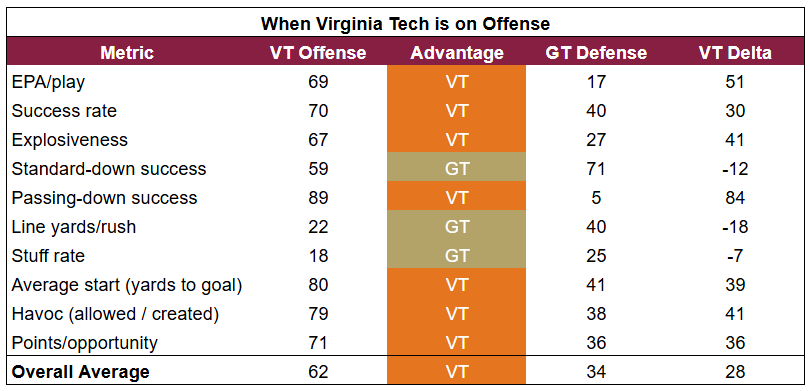
For context, Pitt’s defense had a 19-point advantage and the Hokies put up 499 yards and 33 percentage points on the Panthers. Virginia Tech’s advantage over Cal was 17 points, but the Hokies only gained 390 yards while scoring 20 points. We will learn Saturday how much of the decline was due to injuries and how much can be blamed on having to play out west.
Two areas to watch closely when the Hokies have the ball are stuff rate (how often a run goes for little or no yardage) and passing down success. Georgia Tech has a small advantage in the first category, while Virginia Tech has a huge advantage in the second.
On defense, the Hokies have a significant advantage, although it is not as great as the one it had over Cal’s offense, and the results in Berkeley were decidedly mixed. The Hokies allowed the Golden Bears to gain 403 yards and score 25 points, although a lot of the damage came in the second half of the fourth quarter.
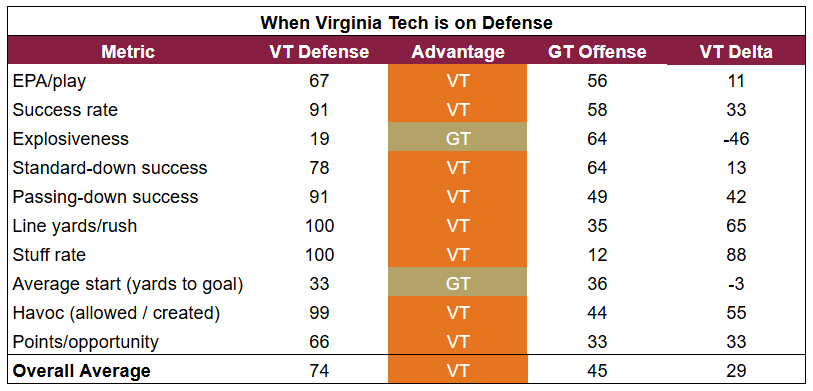
On many plays last week, Brent Pry kept one safety at least 15 yards off the line of scrimmage. Obviously, he’s sick of his unit allowing explosive plays due to miscues. Georgia Tech’s offense, despite its struggles, is in the 64th percentile of explosiveness, which is 46 points better than Virginia Tech’s defense. Like it or not, the high safety look is probably going to make an encore appearance.
Overall, the Hokies score nearly 11 points more per game than the Yellow Jackets while allowing 5 less.
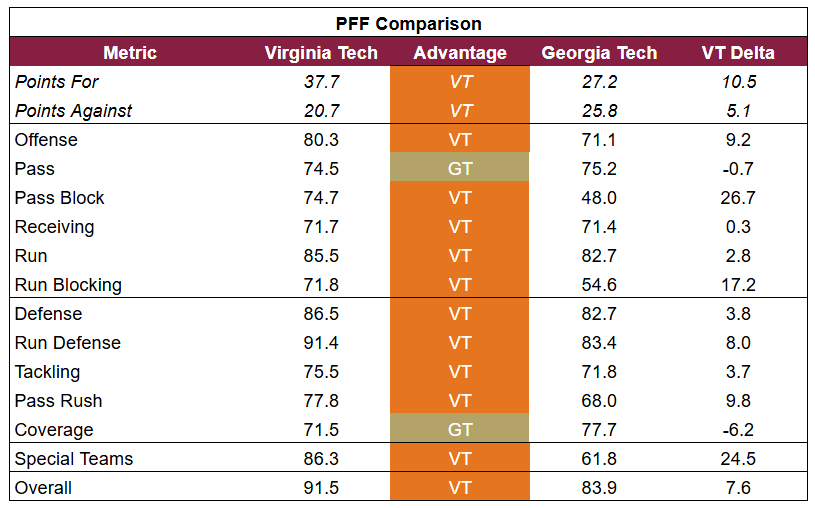
As far as on-field play is concerned, Georgia Tech’s only real advantage is defensively in coverage. Everywhere else, the Hokies are essentially equal or better.
Run defense has been a strength for Virginia Tech all season, and it figures to be again against the Jackets, who could be without their top two running backs. The key to the game for the Hokies will be to shut down the Georgia Tech running game, then tee off on quarterback Alberto Mendoza.
Georgia Tech has been terrible at pass blocking. The Hokies hold a 26.7 point advantage in PFF grades in this category, and this despite their own offensive line looking pretty shaky the last couple weeks.
Overall, Virginia Tech has more paths to victory, but Georgia Tech is trending up after last week’s win over Duke, while the Hokies are trending down. At this point, Virginia Tech’s on-paper advantages aren’t worth much, but the team really should be 6-0, despite all the mistakes the last two weeks.
The Hokies may find a new and creative way to lose, but the law of averages is due to kick in. Virginia Tech is the better, more talented team. More times than not, such advantages are reflected in the final score.