


The first quarter of the season is in the books, and like many teams, the Virginia Tech Hokies have played an FCS team, a G6 team, and a P4 team, which is to say that the numbers are starting to matter.
The polls have Tech outside the top 25, but firmly within the next group of teams vying to receive an official ranking. That status jives with the ratings I’ll be using to grade the team this year. The rankings by metric tell us that Tech has a great offense, alright defense, and good special teams, resulting in a fringe top 25 team.
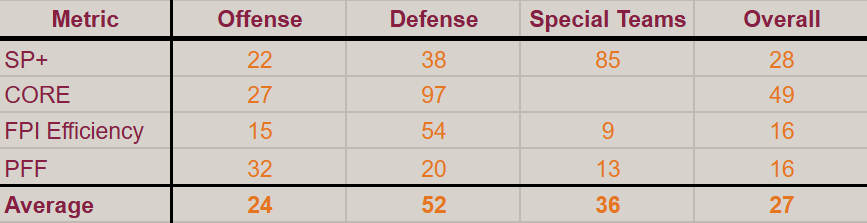
In short, the Hokies have performed as advertised, at least from a 30 thousand-foot view. Dig a bit deeper, though, and the real strengths and weaknesses of the team are revealed.
Offense
Virginia Tech’s PFF grade range on offense is quite narrow. At the extremes, the Hokies have an 83 in passing and a 70 in pass blocking. They excel in passing EPA/play (0.509), passing down success rate (44.4%), and defensive back havoc allowed (1.3%).
The struggles have come on the ground. That might surprise some people after last year’s 3-9 team produced some fairly gaudy rushing stats. One thing to keep in mind is that after the first few games, Philip Montgomery reverted back to using Kyron Drones as a battering ram, which gave the Hokies a man-advantage in the run game. It was as though the Hokies were on one endless power play.
This year, without the numbers advantage, the still-developing offensive line has had to do more work to open holes. The struggles on deep passes haven’t helped.
The two offensive metrics that stand out most in the negative column are rushing explosiveness (0.958) and open-field yards/rush (0.89). Tech’s quick passing game has helped it successfully sustain drives, but an average depth of target of only 6.4 yards does little to move linebackers and safeties back from the line of scrimmage.
Defense
For opposing offenses, it has been feast or famine against the Hokie defense. The outlier range (39.9) is three times greater than for the offense, meaning that Brent Pry’s unit is elite in some aspects, and at certain positions, but below average, at least so far, in others.
Tech has succeeded so far in shutting down the run, outside of one long run by ODU quarterback Quinn Henicle. The team’s PFF grade, 95.0 reflects what fans have seen with their own eyes.
On the other side, Tech’s coverage grade of 54.1 reflects a level of performance through three games that can only be called disappointing. Kaleb Spencer (92.8), Thomas Williams (72.8), and Joshua Clarke (70.4), have all defended the pass well, but Quentin Reddish (43.6), Jaquez White (53.5), and Isaiah Brown-Murray (58.2) have struggled.
Tech has been able to shut down the run thanks to dominant play in the trenches. The Hokies are allowing 0.31 line yards/rush, and they are stuffing the opponent on 45.2% of rushes. The front seven havoc rate (24.4%) is nearly eight times that of the defensive backs (3.5%).
The success rate allowed by play type tells the whole story:
On passing plays: 50.6%
On rushing plays: 21.3%
The game at Boston College
Games at Boston College tend to be sleepy affairs, but there is nothing cozy about a Nor’easter. Today’s menu features both rain and wind, with gusts likely to top 40 mph.
Still, the forecast is not calling for apocalyptic weather. Rather, it’s just going to be chilly and nasty. Regarding football, the weather will be bad enough to impact the game’s final outcome, but not the entire game plan. Tech is still likely to do what it wants in this game, meaning a healthy dose of Ethan Grunkemayer and the short-to-medium range passing game.
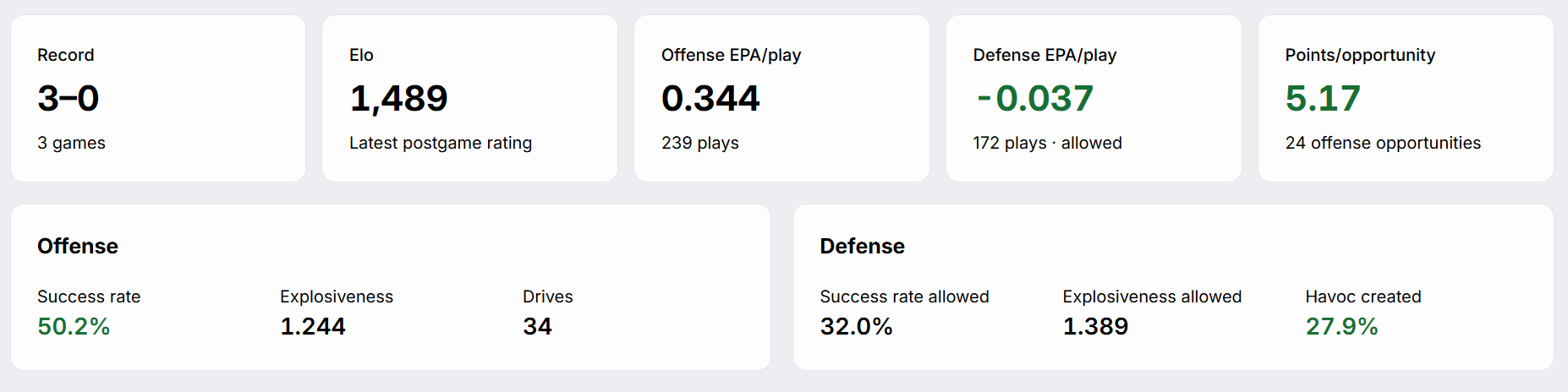
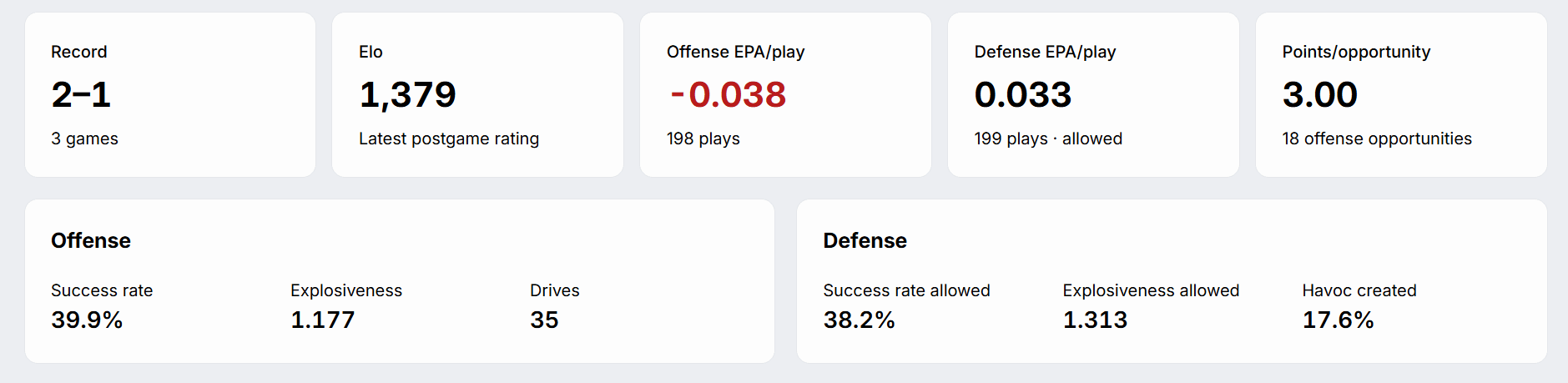
On paper, Virginia Tech has a definite advantage:


When Boston College has the ball
There is no reason to believe that the Eagles will be able to move the ball consistently against the Virginia Tech defense. BC’s offensive EPA/play (-0.038) almost exactly matches what the Hokies allow (-0.037). The weather might conspire to net BC an explosive play or two, but expect the Hokies to drive down BC’s already sub-40% success rate.
When Virginia Tech has the ball
The Hokies may be down their starting left tackle (Justin Terry) and right guard (Montavious Cunningham), but they are the two lowest graders among Tech’s starting five up front. If backups Logan Howland and Brody Meadows can themselves stay healthy, the drop-off in play should not be significant.
A bigger loss would be if Ayden Greene can’t go at wide receiver. Playing young receivers in bad weather is practically asking for an ill-fated turnover, or two. And I’m not just talking about the usual run-the-wrong-route sort of deal. I’m thinking more along the lines of tipped pass interception and fumble after the catch. James Franklin and Fontel Mines weren’t born yesterday. Expect to see a healthy dose of Marlion Jackson and Que’Sean Brown out wide, while Grunk continues to target his tight ends, especially Luke Reynolds, whenever he really needs to make a play.
There has been a lot of speculation in the days leading up to the game that Tech would lean more heavily on the run because of the weather. Perhaps, but if the o-line struggled to get a push in good weather, there is no reason to think that putting those guys on slick field turf will improve their fortunes. If the Hokies are able to do damage on the ground, it will likely be thanks, at least in part, to scheme. The coaches know what they have now, and just like last year’s team, expect some subtle shifts that enable the team to better play to its strengths on offense.
Data sourced from collegefootballdata.com and pff.com. Dashboard visuals are from collegefootballdata.com.