


The Hokies appear on track to win eight games in the regular season, including two of their last three, but let’s not get ahead of ourselves. Virginia Tech has benefitted from a very weak schedule and despite featuring a number of great players on both sides of the ball, there are now gaping holes at key positions due to injuries and talent issues.
By quarters of the season, here is how the wins and losses break down by SP+ ranking as of November 8 (wins are in bold):
Q1: Virginia Military Institute (FCS), Old Dominion (122), at Maryland (79)
Q2: at Boston College (95), Pittsburgh (35), at California (113)
Q3: Georgia Tech (99), at Clemson (47), at SMU (16)
Looking at the 5 FBS wins and 3 FBS losses, here are the splits for average opponent SP+:
Wins: 88.4 (5-0)
Losses: 54.7 (0-3)
Home: 85.3 (2-1)
Away: 70.0 (3-2)
Q1: 100.5 (2-0)
Q2: 81.0 (1-2)
Q3: 54.0 (2-1)
The next three games resemble the last three games, with an average opponent SP+ ranking of 58.3. But even that is heavily skewed by Miami, which currently sits at #3.
The Hokies are big favorites this week against Stanford and will likely be a touchdown (or more) favorite over UVA in a couple weeks. Win both of those games, with a loss at Miami sandwiched in between, and the Hokies would finish 8-4 overall, and 5-4 in the ACC.
Coming off a 3-9 campaign in 2025, those would be great results in James Franklin’s first year. Again, though, fans should not get ahead of themselves. This team is fallible, even at home against Stanford.
Take a look at where Tech stands in three advanced metrics:

The 2026 Hokies are an above average, but far from spectacular, team. As Cal demonstrated, Tech can lose to anyone on its schedule.
As the quality of its opponents has improved, Tech’s SP+ numbers have, not surprisingly, gotten worse:

At this point, I would expect the Q4 numbers to look a lot like Q3. For that to happen, the Hokies will need to play very well against Stanford.
Will they?
Probably.
Stanford has been notoriously terrible east of the Mississippi River since joining the ACC in 2024.
Although Stanford’s trip was not impacted by Friday’s FAA flight groundings, travelling from Palo Alto, California to Blacksburg, Virginia is not for the faint of heart.
Throw in a blast of cold weather and things look even better for the homestanding Hokies.
Those two factors will be a lot to overcome, especially for a team that does little, if anything, well.
There are no fine data points to dig into here. Tech has the advantage in just about every aspect of the game. Offense, defense, special teams. Even the offensive line has a chance to look good.
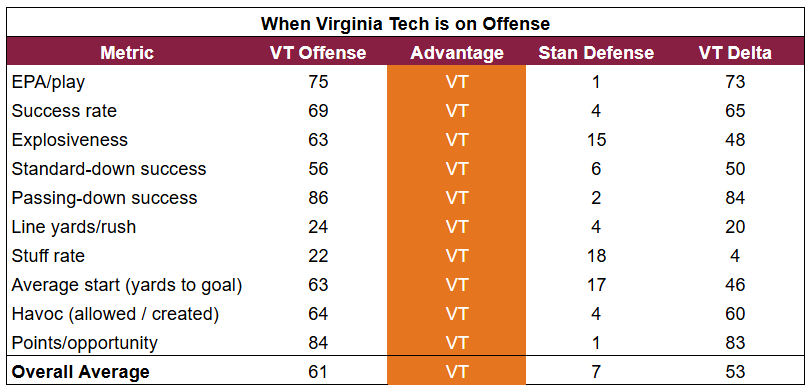
Only in stuff rate is Stanford’s defense within 20 percentile points of Virginia Tech’s offense. Overall, the Cardinal defense is worse than Old Dominion’s, but probably better than VMI’s.
Tech’s pass defense is bad and Stanford can throw it some. Will that matter?
It shouldn’t.
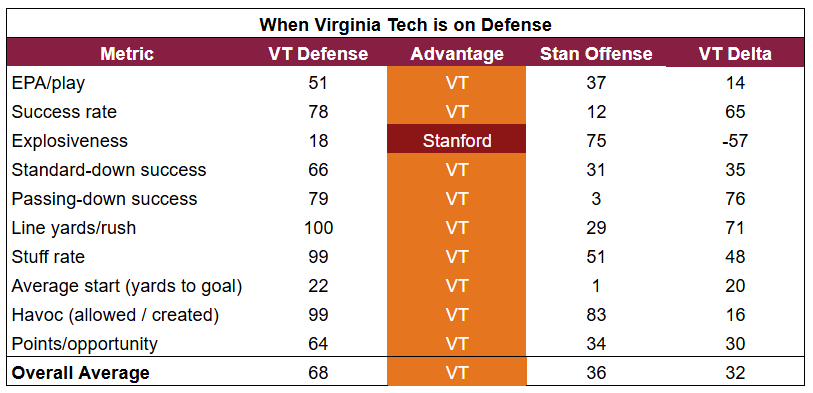
The Hokies defense has an advantage in every metric except explosiveness. The disparity there (57 percentile points better for Stanford) is concerning and suggests the Cardinal could reel off a few big plays, but Tech’s advantage is so great in every other area that there is no reason to believe Davis Warren & Co. will be able to keep up with the Hokie offense.
PFF continues to love the Hokies, even if the blocking grades have declined significantly in recent weeks.
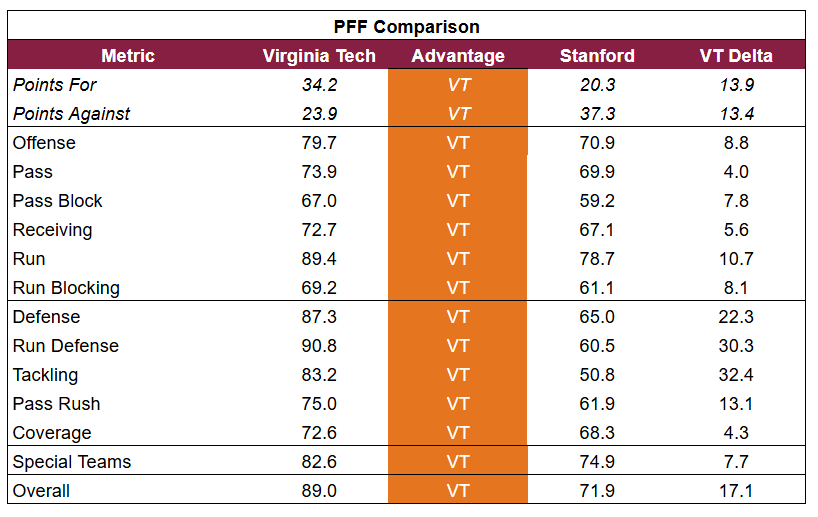
Substituting letter grades for PFF grades, for the season Virginia Tech is a B+ team (C+ offense, B+ defense, B- special teams) and Stanford is a C- team (C- offense, D defense, C special teams).
At this point in time, given the injuries up front, the Hokies are probably playing at a B to B- level overall, which is still much better than Stanford.
All of this is to say that Saturday night’s game should not be close. The Hokies should win in a blowout.
However, teams seldom go up and down the field in frigid night games. Throw in the fact that Ethan Grunkemeyer has taken a beating of late, and we might see the Hokies lean more on the run game than they have throughout the year.
The Hokies can still win comfortably with Jeffrey Overton Jr. getting 20+ carries, Marcellous Hawkins getting 10+ and Grunkemeyer throwing less than 30 times, but the difference on the scoreboard might not be as great as it would be if the game were played in warmer weather earlier in the season.
In a strange twist, the cold increases Virginia Tech’s chances of victory while simultaneously making it more likely that Stanford keeps it close.
I like your optimism, but Tech seems to have a way of making horrible teams look like National Title contenders.