


As eventful as things have been in Blacksburg since the 2025 season mercifully came to an end, you have no doubt noticed that the inverse has been true here at Hokie Analytics.
The reason is simple. Since others own the hot take space, I chose to sit back and observe.
Like everyone else, I want to know what is going on in college football and how it is all going to impact Virginia Tech. How do the Hokies win in this environment? And not just for a season or two. What can the past teach us about how to sustain success long into the future?
To answer these questions I went back and looked at the four teams everyone had pegged as the best in the ACC when the conference expanded in 2004. Not coincidentally, they are the only four schools that have sustained excellence over an entire generation in my lifetime (since 1984).
Part of the utility of such an analysis is comparing teams across years. In order to do that, I settled on the simplest complex metric in existence today. Simple Rating System (SRS) “combines scoring margin and strength of schedule to rate teams. The rating indicates expected margin vs. an average team, adjusting for home field advantage.”
In an attempt to keep the analysis clean, I defined a generation as 17 seasons. In every case except Clemson, those 17 seasons played out over 16 years (the Tigers needed an extra year because SRS data is not available for the Covid season in 2020).
Here is a rundown of the four programs and how they stack up over the best 17-season period in their respective modern histories.
4) Virginia Tech (1994-2010)
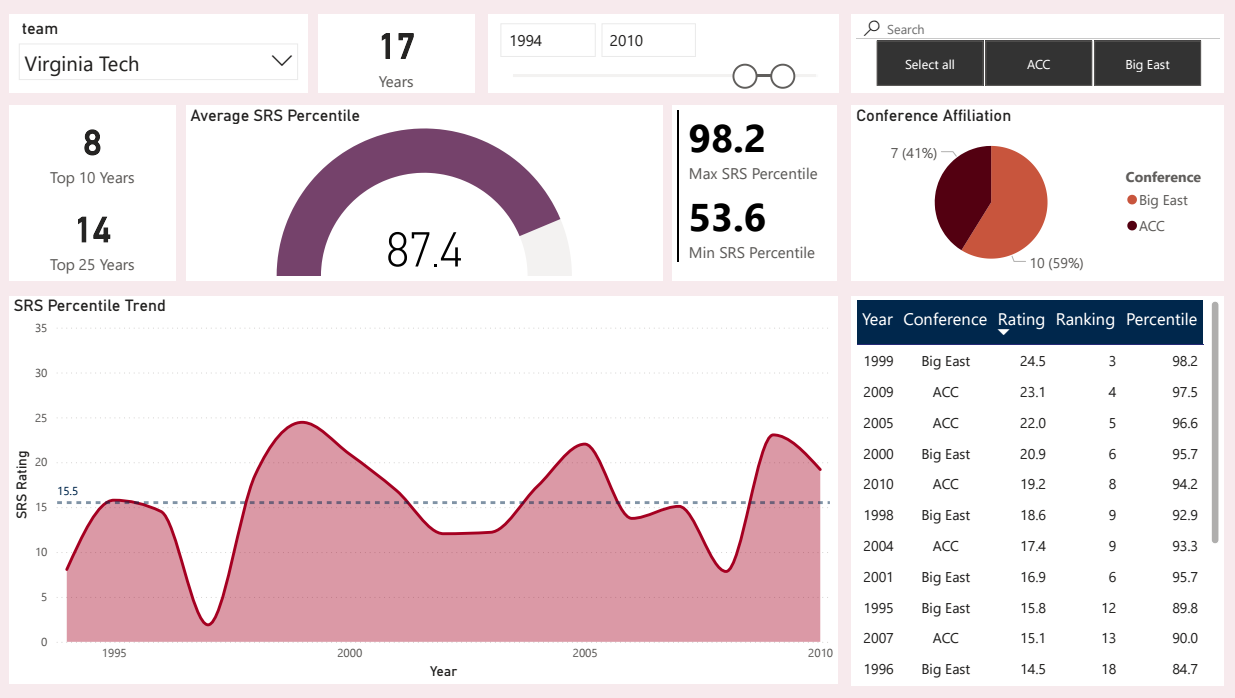
Best Season: 1999, 11-1, National Championship appearance, 24.5 and #3 in SRS
Historically Elite Seasons (30+ rating): 0
Peak (Best 5 in a row) Seasons: 1998-2002, 1 top-5 and 4 top-10 SRS
Average SRS: 15.5
Median Season: 1995, 10-2, Sugar Bowl Champions, 15.8 and #12 in SRS
What felt like a period of sustained, extended excellence for Virginia Tech could more accurately be described as a period of peaks and valleys during which the floor was high and, in peak years, the ceiling put the Hokies among the nation’s best teams.
A few things stand out with the Hokies during Beamer’s golden era.
First, and befitting a program in which development was paramount, the Hokies tended to build over several seasons toward truly exceptional teams. Only in 1999 and 2000 did the Hokies play at a level commensurate with those competing for a National Championship.
Second, Beamer really did have the Hokies consistently among the top-10 teams in the country. However, they were only a top-5 team in three out of the 17 years.
Even in top-5 years, the Hokies were not truly elite. The Hokies never had an SRS rating above 25, whereas the three other teams on this list all had at least one season with a rating over 30.
Still, consistent excellence was the name of the game. The median season, which was the ninth best, was the 1995 Sugar Bowl championship team.
3) Clemson (2007-2024)
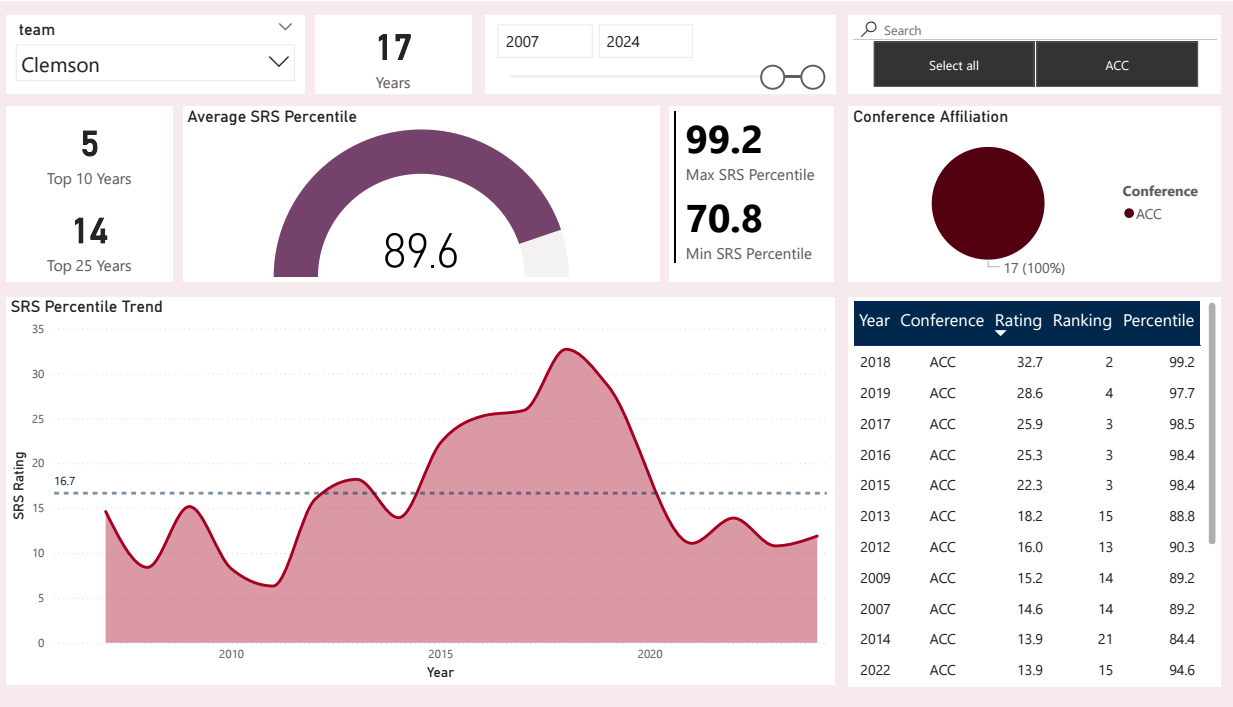
Best Season: 2018, 15-0, National Champions, 32.7 and #2 SRS
Historically Elite Seasons (30+ rating): 1
Peak (Best 5 in a row) Seasons: 2015-2019, 5 top-5 SRS, 2 NCs
Average SRS: 16.7
Median Season: 2007, 8-4, Chik-Fil-A Bowl appearance, 14.6 and #14 SRS
Without Clemson’s run of greatness in the second half of the 2010s, the Tigers would not have made this list. But oh that five-year run (arguably six, but there are no data for 2020).
Clemson finished in the top-5 every year from 2015-2019, and the Tigers won two National Championships in the process.
The best season, the undefeated National Championship run in 2018, put the Tigers in the conversation for the best team of the millennium, if not all of college football history. However, even in that amazing year, Clemson still finished with the second best SRS rating. Alabama, the team Clemson destroyed in the National Championship game, still finished the year with a higher rating.
Outside of those five years, Clemson was somewhere between good and very good. The median season, the 2007 team that went 8-3 in the regular season before losing in the Chik-Fil-A bowl. Even though the 2007 team finished #14 in SRS rankings that season, compared to #12 for the Hokies in 1995, there was a big difference between capping the year off with a major win and ending with a loss in an upper-middle tier bowl.
2) Miami (1986-2002)
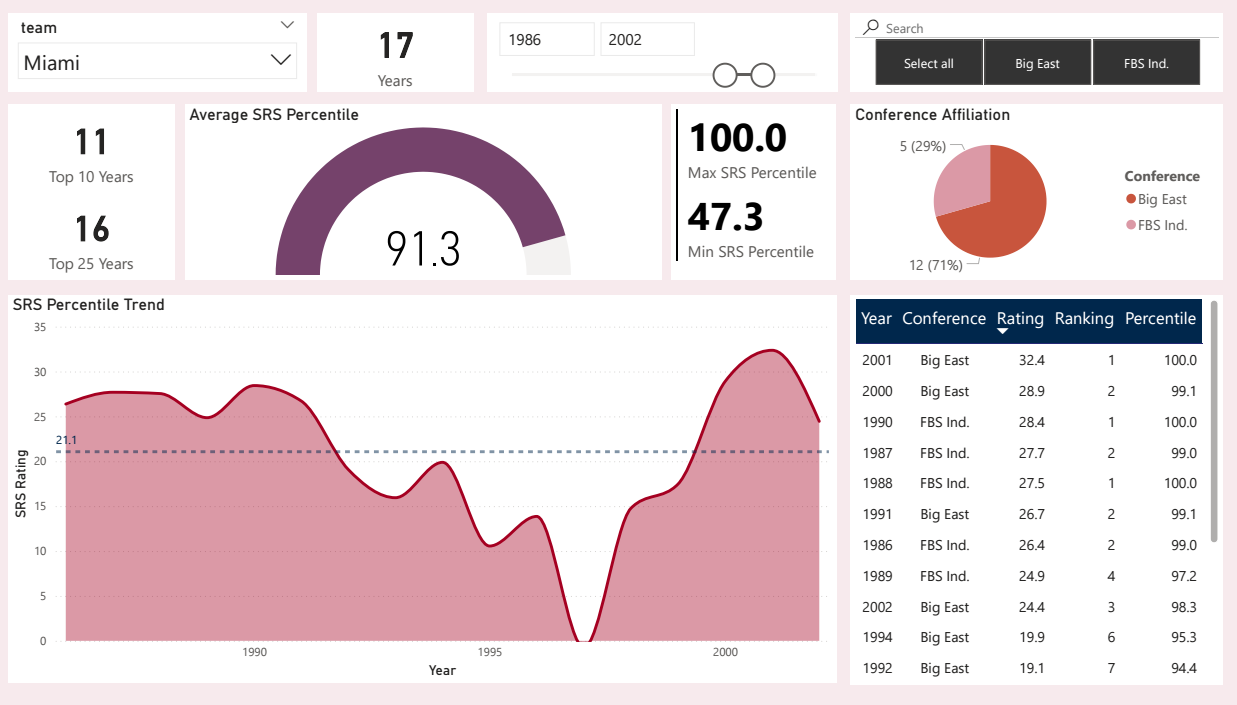
Best Season: 2001, 12-0, National Champions, 32.4 and #1 SRS
Historically Elite Seasons (30+ rating): 1
Peak (Best 5 in a row) Seasons: 1987-1991, 5 top-5 and 2 best SRS, 3 NCs
Average SRS: 21.1
Median Season: 2002, 12-1, NC appearance, 24.4 and #3 SRS
Miami is one of very few programs in the country capable of fielding a team that merits mention among the all-time best.
The 2001 Hurricanes would probably win a vote for team of the decade. The only other contenders would be 2000 Oklahoma, 2004 USC, 2005 Texas, and 2009 Alabama.
The Hokies barely lost to the Hurricanes in 2001 (oh, Ernest Wilford…) and hung with 2004 USC and 2009 Alabama into the fourth quarter.
For my money, that Canes team belongs in the same conversation that includes 2019 LSU among the all-time best college football teams. Sports Illustrated agrees, as the venerable media organization placed the 2001 Hurricanes atop a list of the top 25 teams of the last 25 years. As SI summarized:
The term “loaded” has never applied more accurately to a team than these Hurricanes. Thirty-eight players on the ’01 Canes were drafted by the NFL. They led the nation in scoring defense, allowing just 9.4 points per game, and in takeaways (45). Only one of their 12 wins [Virginia Tech!] was by single digits, and they beat five ranked opponents by an average of 32.8 points. They were so good, rookie head coach Larry Coker just had to keep from screwing it up.
The problem with Miami has never been the heights the team could reach. Rather, the issue has been consistency.
Two factors, above all else, have conspired to make Miami a wildly unpredictable program: cheating (especially paying players long before it was legal) and the coaching carousel.
If you run a Google search for Miami football sanctions hoping to learn about what happened in the mid-1990s, you will find that more refined search criteria are required because of the sanctions following the Nevin Shapiro scandal in 2011.
If Miami could ever get its act together for an extended period of time, the program could become a real juggernaut. But then, Miami would not be Miami without all the semi-legal swagger.
1) Florida St. (1987-2003)
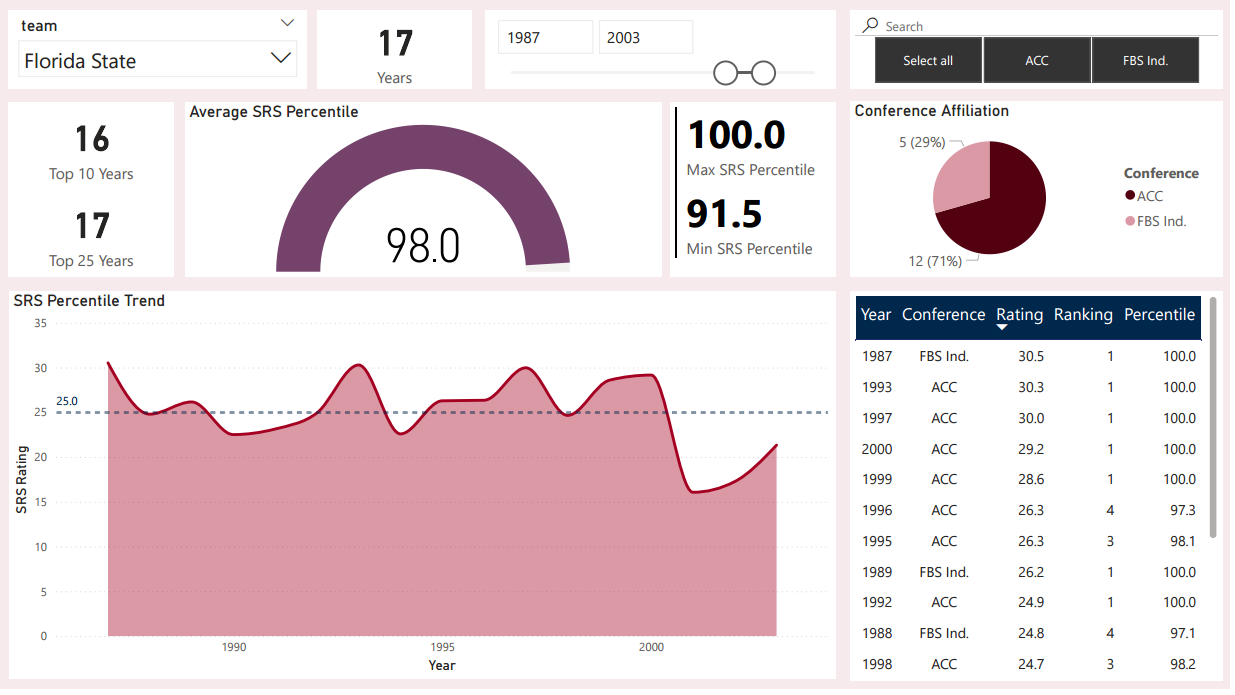
Best Season: 1987, 11-1, Fiesta Bowl Champions, 30.5 and #1 SRS
Historically Elite Seasons (30+ rating): 3
Peak (Best 5 in a row) Seasons: 1996-2000, 5 top-5 and 3 #1 SRS, 1 NC
Average: 25.0
Median: 1992, 11-1, Orange Bowl Champions, 24.9 and #1 SRS
In the 1990s, a top-5 finish must have felt like a birth right for Florida St. fans. In the modern era, only Nick Saban’s Alabama teams are comparable. Not until 2001 was there finally a drop off in FSU’s level of play.
During their run of greatness, the Seminoles’ average team was better than the 1999 Hokies. However, the only time during this run that FSU produced an undefeated national champion was in 1999 - the Chris Weinke/Peter Warrick team that came back to win the Sugar Bowl over the Michael Vick-led Hokies.
The one annual slip-up almost came to be expected, but beating the ‘Noles always required the opponent to be either great themselves (think Steve Spurrier’s Florida teams) or really good and play the game of their collective life (think 1995 Virginia).
In many ways, Bowden and Beamer followed the same formula. Florida St. pushed the boundaries a bit more with regard to NCAA rules, but the general blueprint was the same, especially when it came to staff stability.
The run of greatness ended following the 2000 season. After FSU’s 13-2 loss to Oklahoma in the National Championship game, Mark Richt left to become Georgia’s head coach. He was succeeded by Bobby Bowden’s son, Jeff, who proved to be a major downgrade.
In addition, in 2001, the Seminoles started redshirt-freshman Chris Rix who was not ready to play at a championship level. Those two factors were the primary drivers of the decline in the team’s on-field performance.
Final thoughts
Three of the teams featured in this article - Virginia Tech, Clemson, and Florida St. - were led by current or future Hall of Fame coaches. Miami had a coaching carousel, but the Hurricanes were at their best under Jimmy Johnson and Dennis Erickson, both Hall of Famers.
This commonality is important for understanding the critical drivers to sustained success in college football - it all starts with great coaching.