


Last week you may have noticed that I did not send out an article previewing Virginia Tech’s game with Clemson. As you will see below, that is not because I didn’t write one. Rather, I committed a cardinal sin that no doubt plagues many alums of ole VPI - I allowed my vt.edu email address to cross the 5 GB boundary, which resulted in all new emails getting bounced back to the sender until 3 days after I brought the contents of said inbox under 5 GB, which was Saturday morning. Naturally, without access to this email inbox, I could not authenticate publication. Thus, the article sat in the site’s draft section.
As the Hokies are off this week, I figured why not send out the preview. I haven’t added or changed anything. I got some stuff right, and some wrong. Most glaring is the omission of Clemson’s three weeks to prepare for the game. That clearly had an impact on the game’s final score. Overall, I hope this further contextualizes what happened last Saturday night in Clemson, South Carolina.
What bothered me most about Virginia Tech’s downfall in the late Beamer era was something surprisingly small, but nonetheless meaningful.
I hated hearing television announcers hype the Hokie special teams units that had long since ceased to be special.
By the late 2000s, Tech had become pretty average on special teams. And they only faded from there. Gone were the days when the Hokies trotted out All Americans on the punt block team. In 2013, the Hokies played walk-ons in punt coverage against Alabama. That didn’t work out so well.
Christion Jones jogged(!) 70 yards to the house in the opening minutes of the Chick-fil-A Kickoff game.
My, how the mighty had fallen.
That feeling sprang to mind as I reviewed Clemson’s 2026 stats, both team and individual.
The Hokies are playing the Tigers in a Saturday night game at Death Valley. It feels like it should be a big game. However, on paper, these Tigers are no better than Georgia Tech or Cal.
At some positions, and in some aspects of the game, they are downright horrible.
If not for the jersey, and Dabo’s record of success through the 2024 season, this game would merit no more interest than Tech’s games from the past two weeks.
These Clemson Tigers are shockingly bad in two critical areas:
Outside of Jerome Carter (90.4 per PFF), the secondary cannot tackle. None of the four remaining starters have a tackling grade above 52, and two grade out below 40. Yikes! The front seven are not much better. Hokies tight end Luke Reynolds could have a massive game.
Quarterback Tait Reynolds carries an overall grade of 51.4, and he does not eclipse 55 in either rushing or passing. In only one game (72.7), against North Carolina, has he graded out above 60 overall. He has one big time throw all season, good for a 0.6% rate. Part of that is his average depth of throw, a mere 7.1 yards. Clemson does not trust him to throw the ball down the field. And yet, even with all the dink and dunk passes, Reynolds has still racked up a 3.8% rate of turnover-worthy plays. He has been sacked 17 times out of 72 pressures, good for a 23.6% rate. His 2.8 seconds of time-to-throw suggest that despite the short route concepts, he is not seeing the field well, and as a result he holds onto the ball.
While these particular areas stand out above all else, there are plenty of other favorable matchups for Virginia Tech to attack.
When the Hokies have the ball
Clemson has a solid, but not spectacular, defense. The Tigers smothered two non-power opponents (3.5 points per game), allowed an average of 15 points in wins over North Carolina and Cal, but surrendered an average of 46 points per game in losses to LSU and Miami.
Virginia Tech should land about in the middle of the last two groups.
The Hokies have scored an average of 28.6 points in five games (one in a monsoon) against power conference opponents, while Clemson has allowed 30.5 points in such games. Thus, a reasonable range of expectation for Virginia Tech is 27-31 points scored.
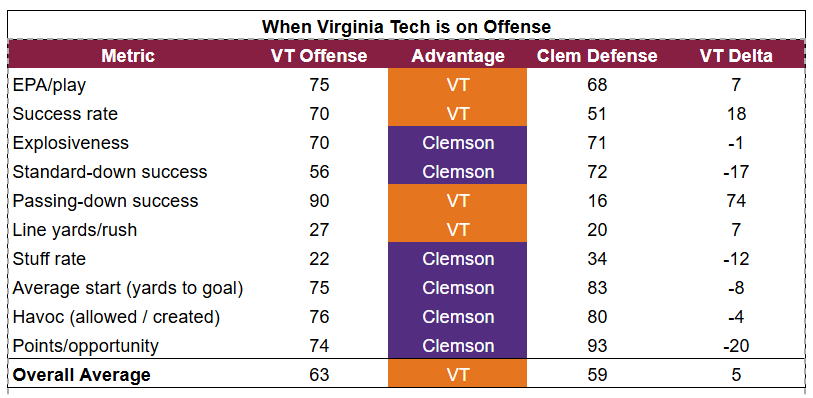
A few individual matchups stand out:
Clemson is in the 72nd percentile in standard-down success, but only the 16th in passing-down success. As a result, the Hokies should do pretty well on third down plays.
Clemson’s defensive front seven is not good against the run — they are roughly in the bottom third in both line yards per rush and stuff rate — and when you factor in the poor secondary tackling, one can easily imagine Jeffrey Overton having a big game.
The Hokies have been pretty good at scoring touchdowns when they get the opportunity (74th percentile in points per opportunity), but Clemson’s defense is in the 93rd percentile in that same category, which means the Tigers are good at forcing field goal attempts.
Factoring in the road atmosphere at night, if Tech commits a bunch of penalties and fails to force turnovers, the offense could sputter a bit, resulting in more like 20 to 24 points scored. On the flip side, if the Hokies force a couple turnovers, which they should given Clemson’s woes at quarterback, Tech could easily notch somewhere around 35 points.
When the Hokies are on defense
Last week, Thomas Williams and Joshua Clarke shared snaps at one cornerback position, with each grading out in the mid-60s in coverage. On the other side, Jaquez White played every snap, grading out just above 50 in coverage.
In four (non-monsoon) games against P4 opponents, White has averaged 53.5 in coverage, which is 6.5 points below the baseline. His poor play has cost the Hokies time and again.
Williams, unfortunately, will miss this game with an injury he sustained last week. Given Cam Chadwick’s struggles as the fourth cornerback, Clarke and White will likely get the vast majority of the snaps. You can bet that, to the extent Tait Reynolds is capable, Chad Morris will try to test White, especially on routes involving a double move.
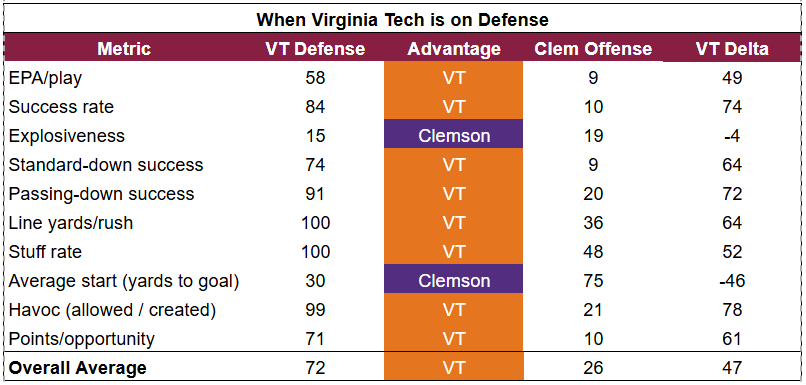
Beyond the cornerback rotation, I really cannot stress enough how atrocious Clemson’s offense has been in the first half of the season.
Out of 10 metrics, Virginia Tech’s defense gets the better of Clemson’s offense in 8. What is truly shocking is the margin of difference. The delta is a whopping 47 percentile points on average across the 10 metrics.
Virginia Tech’s defense is 72 percentile points better than Clemson’s offense on passing down success! It is 64 points better on standard down success. Will Clemson’s offense even cross the 50?
Assuming the offense does not give the ball away deep in its own end, there is no reason to believe that Clemson can score more than 21 points against the Hokies defense.
I’d put the over-under at 13.5.
Final thoughts
Along their offensive lines, both teams are weakest at the guard position. Look for Tom Allen and Brent Pry to attack the center of the opposing line with delayed blitzes and stunts.
To that end, I would not be surprised if a missed assignment up front leads to a free shot on either quarterback, resulting in an injury. Clemson has already elevated its second string quarterback to a starting role, although there are whispers that former starter Christopher Vizzina may be close to returning. According to Clemson offensive coordinator Chad Morris, Vizzina was a full go in practice this week.
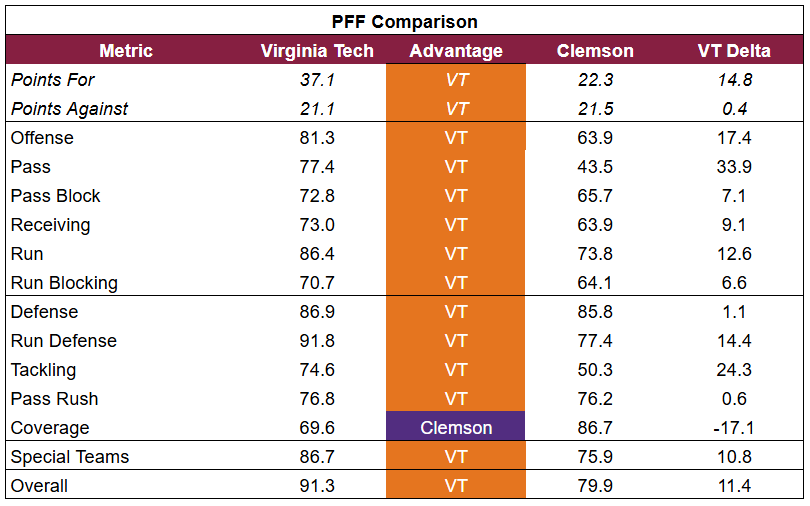
A quick scan of each team’s PFF grades shows that Virginia Tech has played better football in every phase of the game by a wide margin this season.
Tech SHOULD win the game by double digits and make a statement on national television about the new pecking order in the ACC.
No, a win would not make the Hokies a tier 1 team in the conference. But it would put them in the conversation for mention in the second tier alongside Wake Forest.
And, realistically, Wake’s hold on that position is tenuous. The Hokies have an elite head coach, and he’s signed for the long-term. Wake, meanwhile, is seen as a stepping stone job.
All that said, there is no guarantee Virginia Tech will win the game. Death Valley is no joke, especially at night. And Clemson still has a solid advantage in team talent, even if that talent does not appear as well developed as it was in years past.