


I ended last week’s article with these fateful words:
[T]he Hokies should win the game by 7 to 10 points.
Word choice is everything.
Virginia Tech ended up outgaining Pitt by 200 yards, yet they managed — through a combination of turnovers, busted assignments, and questionable officiating — to lose in the most excruciating fashion possible.
How does the end result line up with my statement, and the entire crux of the article?
Quite well, as a matter of fact.
The Hokies were clearly the better football team. When asked after the game about John Love’s missed field goal as time expired, James Franklin stated that the Hokies had 20 plays more responsible for their defeat than the missed kick.
That’s an awful lot of plays that had to go in Pitt’s favor in order for the Panthers to squeak out a victory.
While it is true that Pitt lost starting quarterback Mason Heintschel to a season-ending knee injury in the third quarter, his backup, Holden Geriner, arguably played better in his two quarters of action.
Pitt’s 24.8% post-game win expectancy puts a nice bow on the topic. The Hokies should have won by 7 to 10 points, and perhaps even more, but they lost by two.
As the famous sports adage goes, “That’s why the play the games!”
No reason to expect a close game
Cal is a hot a mess. It’s personnel, both players and coaches, appears in flux, with injuries and performance-related demotions leaving many wondering just who exactly is going to participate in the game against the Hokies.
The cold hard truth is that it probably does not matter. The Hokies are a much better football team, and Cal does not have an advantage they can exploit anywhere on the field.
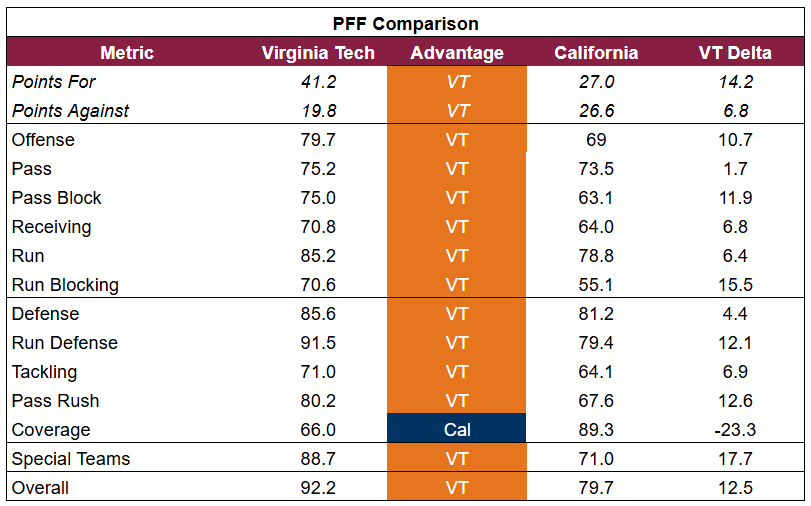
According to PFF, Cal does precisely one thing better than Virginia Tech: cover wide receivers.
But with an injured starting quarterback, the Bears are not in a position to challenge the Tech secondary. On the other side, Cal has injuries in its secondary, and Tech quarterback Ethan Grunkemeyer is likely to have plenty of time to sit in the pocket and wait for a receiver to come open.
And with his 74% completion percentage, Grunkemeyer has demonstrated an ability to fit passes into tight spots.
That said, the Hokies have such a distinct advantage on the ground, that one can hardly imagine Grunkemeyer putting up yardage comparable to what he did against Pitt.
How the Hokies will attack on offense
At present, the only thing holding back the Virginia Tech offense is inconsistent run blocking. As the PFF team grades table above shows, Tech isn’t bad at run blocking. In fact, the Hokies do a much better job in run blocking than the Cal offensive line.
The problems are mostly due to youth and injuries. Neither will be completely solved this season, but improvement is certainly possible.
The good news is that Cal’s defensive line struggles to get penetration against the run.
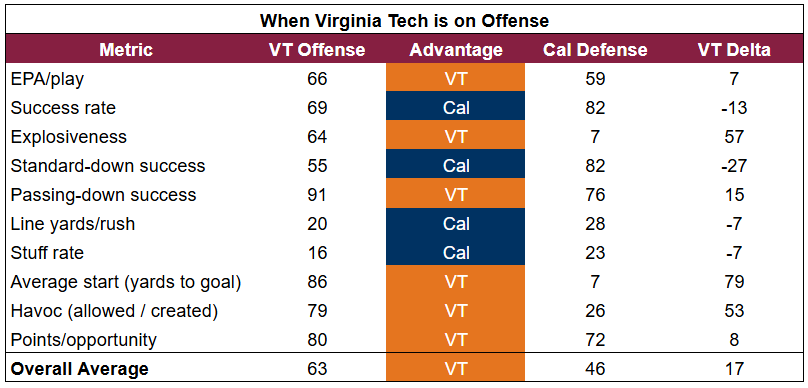
While the bears grade out alright according to PFF, advanced stats reveal Cal’s struggles to win battles in the trenches and force stops at or behind the line of scrimmage.
In fact, the numbers tell the story of a bend and break defense. These Bears to do not stress offenses by playing in the backfield and they also allow a ton of explosive plays.
Yet, Cal’s defense is surprisingly good at limiting successful plays, especially on standard downs, so don’t expect the Hokies to just gash the Bears’ defense play after play. Rather, look for a combination of short fields and big plays to lead to Hokie points.
What to expect when Cal has the ball
Cal’s offense will be completely overmatched in this game. With injuries at quarterback and running back, things are even more bleak than the numbers suggest.
And the numbers tell a brutal story.
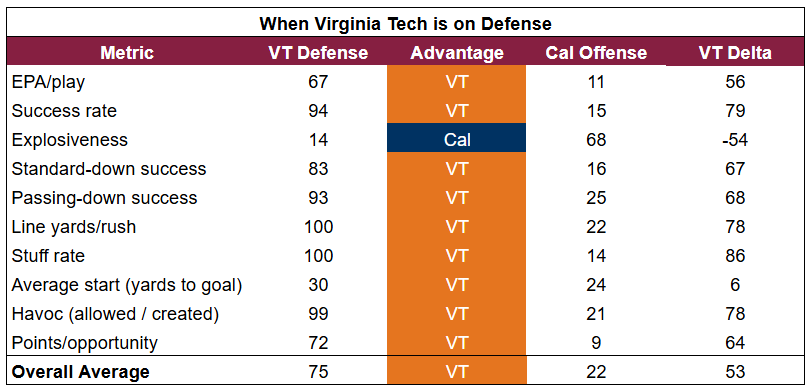
The Hokies have allowed a lot of explosive plays, mainly due to missed assignments in the secondary. Not surprisingly, that is an area where Cal will have an advantage.
But out of 10 advanced stats, that is the only area where Cal has an advantage.
Quite frankly, the disparity is so great in just about every metric, that it is difficult to imagine Cal doing much on offense.
The Hokies should completely own the line of scrimmage, forcing long second- and third-down situations.
Look for Brent Pry’s unit to (finally) generate some turnovers (plural). The expectation should be around three.
Surely, Cal will do a few things they have not shown on tape, and that may result in a scoring drive or two, but after that, the Hokies should strangle the life out of this offense.
Final thoughts
If I had told you before the season started that five games in the highest-graded player on Virginia Tech’s offense would be a lineman, would you have believed me?
Right tackle Aidan Lynch takes the honors, by less than a point over Ethan Grunkemeyer, whose overall grade (77.4) is lower than his conventional stat line would suggest.
Next to Lynch, Michael Troutman has logged over 150 snaps in place of Montavious Cunningham, who has battled injuries. Troutman’s overall grade (69.1) is nearly 12 points higher than Cunningham’s, so at this point, I would expect Troutman, as the younger player, to take over as the starter even when Cunningham is fully healthy.
What Tech really needs is a solution at left tackle, where Justin Terry and Logan Howland have both graded out around 60. For now, Terry is hurt, so either Howland will get the start, or Layth Ghannam will slide outside, with Brody Meadows or Tommy Ricard filling in at the vacated guard position.
Cal is not particularly strong along the defensive line, so look for Tech’s offensive line coach Matt Moore to focus on getting his best five both on the field and solidified at one position, so they can gel during the current stretch of games against weaker opponents.
The Hokies will need better offensive line play if they hope to go on the road at Clemson, SMU, and Miami and have a chance to win.