


I never thought I would live to see the day when Virginia Tech was this bad and Virginia was this good.
But on gameday morning, have I indeed lived to see that day?
It’s debatable.
Virginia is a good team with no obvious holes on the roster. Virginia Tech is a misaligned, broken team with a few very good pieces, but also some glaring holes.
Still, the question remains, are the Wahoos really that much better than the Hokies?
In the age of mega-conferences and unbalanced schedules, it’s not such an easy question to answer.
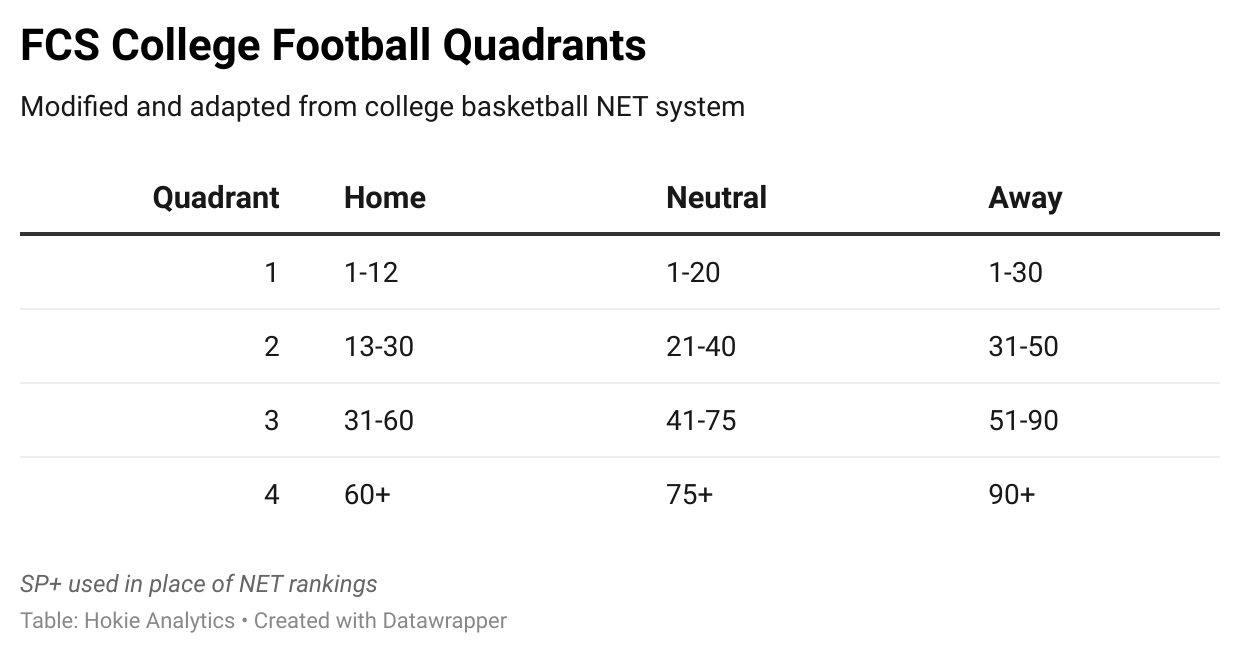
In an attempt to bring some quantitative rigor to bear, I modified the college basketball quadrant system, adapting it for college football.
In basketball, there is no FCS. All 350+ teams in Division 1 are grouped together.
Since there are less than 140 FBS teams, the ranking windows for the quadrants had to be compressed.
And speaking of rankings, there is no NET for college football, so I used SP+, which is the closest advanced metric.
Here is where I drew the lines for the quadrants:
The Hokies did not play the world’s toughest schedule in 2025, but their opponents ended up having much better seasons than many would have guessed back in August.
UVA will be Tech’s ninth bowl bound opponent. If Florida St. beats Florida, the Seminoles will become the tenth bowl eligible opponent.
Only South Carolina and FCS Wofford will join the Hokies in staying home for the holidays.
Tech’s average opponent this year has a 7-4 record and is ranked #43 in SP+.
Overall, the Hokies have played a lot of good to very good teams. Outside of Wofford, there were no games that any team, much less this Virginia Tech team, could just sleepwalk through and expect to win.
Virginia’s schedule is another story altogether.
The Cavaliers have played six bowl eligible teams, four of which are 6-5. Two other teams, Florida St. and Washington St., are 5-6 and could punch their ticket to a minor bowl with a win on Saturday.
The average UVA opponent is 6-5 and ranked 71st in SP+.
Here is a comparison of the two teams’ resumes:
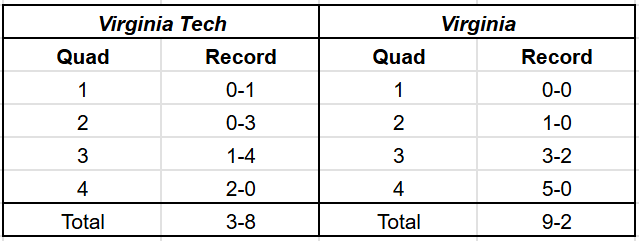
If the Hokies had played the Cavaliers’ schedule - replace Virginia Tech’s Quad 1 game and two Quad 2 games with Quad 4 games - it is very likely that they would be at least 6-5. Brent Pry would likely still be Hokies’ coach.
Don’t believe me? Let’s review the first four games on UVA’s schedule
vs. Coastal Caroline (6-5, #112 in SP+)
at NC State (6-5, #66)
vs. William & Mary (FCS)
vs. Stanford (4-7, #107)
Against that schedule, the Hokies would have likely entered the week 5 matchup against Florida St. with a 4-0 record. And the Wahoos got the Seminoles at home.
Brent Pry would not have been fired, so opt outs wouldn’t have hurt the team’s depth.
Under that hypothetical, there is little chance the Hokies would have been forced to start two true freshmen against UVA.
But the schedule is what it is, and it has played out very well for UVA. The Hoos even had an extra week to prepare for the Hokies.
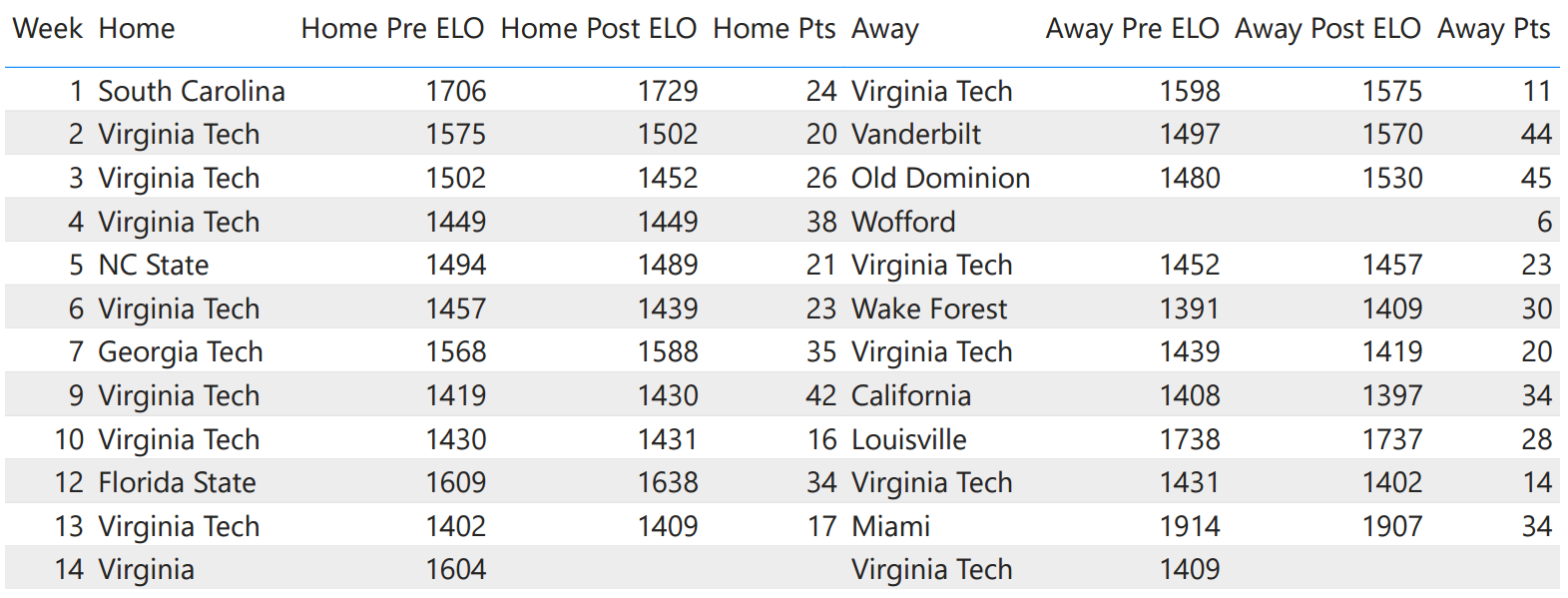
And that could be decisive, because in ELO terms, the Hokies (1409 ELO) look more like a marginal 5-7 team than one about to finish 3-9, while UVA (1604 ELO) is closer to 7-5 than 10-2.
When Virginia Tech is on offense
The Hokies need to finish promising drives with touchdowns, period.
Since Tech has gone all in on the run game, the offense has moved the ball alright between the twenties, but everything bogs down in the redzone.
Kyron Drones can give the Hokies a man advantage in the run game, but the wide receivers, three of whom are on the field for almost every play, are practically invisible.
And has anyone else noticed Benji Gosnell’s disappearing act this year? After catching 32 passes for 341 yards last year, Gosnell has just 12 receptions for 86 yards this year.
At 6’5”. 254 lbs., he would seem as good a target as the Hokies have in the redzone. With Ayden Greene questionable due to injury, perhaps Gosnell gets a few more targets today than has been the norm of late.
Those targets might come by default. The Hokies are so thin at receiver that Greene’s health might force Philip Montgomery to run more plays out of two-tight end formations.
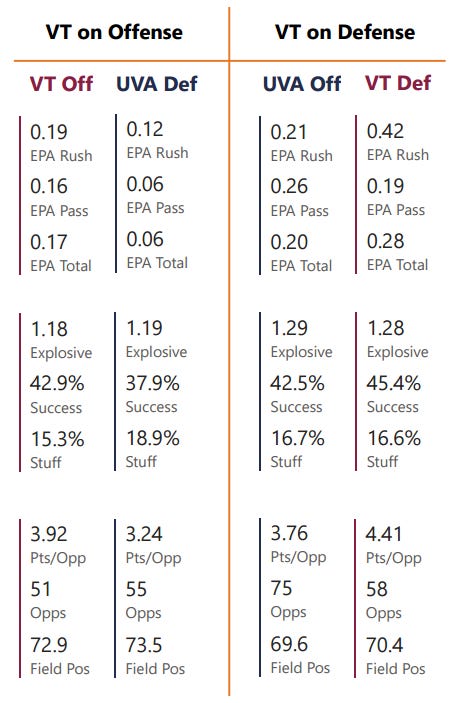
UVA’s rush defense is ok, but the team really excels against the pass. As teams have done of late, it seems likely the Cavaliers will aim to shut down the pass, get a lead, then force the Hokies to try to throw the ball in order to come back.
Statistically speaking, the two biggest concerns are field position (UVA’s opponents start each drive, on average, at the 26-yard line) and staying ahead of the sticks (the Hoos allow a success rate under 38%).
Overall, there is no reason to think the Hokies will score more than 20 points at Scott Stadium.
When Virginia Tech is on defense
Virginia is pretty pedestrian on offense. Their EPA numbers are indicative of a team with higher explosiveness and success numbers than the Cavaliers have achieved on the field, so there is a bit of a disconnect, perhaps due to biased sampling (see: schedule = easy).
Virginia Tech’s opponents have been able to nickel-and-dime the defense, methodically driving the length of the field without the aid of a big play. In theory, Virginia could do this too, but that success rate, which at 42.5% unadjusted is actually lower than Virginia Tech’s, suggests that consistency could be an issue.
Translation: bend-but-don’t-break might be a more successful defensive philosophy this week for the Hokies than it was against FSU and Miami.
Winning the game will require a Herculean effort by the defensive line and no stupid late hit penalties (I’m looking at you, Ben Bell).
Tech’s back-seven is at a moderate disadvantage in terms of skill, track record, and experience. The scheme will be vanilla because that is all the freshmen can handle. Tackles will be missed, gap fills will be late, and receivers will get lost in zone coverage.
If the big boys can win in the trenches, it will largely negate all these disadvantages. However, if PFF is any indication, the Wahoo’s have as strong an offensive line as Tech does a defensive line.
Final thoughts
Speaking of PFF and holes in the line-up, consider the number of players on each side of the ball who have played more than 150 snaps and graded out lower than 60 (the PFF baseline):
Offense
Virginia Tech - 8 (5 of who are linemen)
Virginia - 3
Defense
Virginia Tech 3 (Jojo Crim just misses the cut at 149 snaps)
Virginia - 0
If ever there was a telling stat, it’s that count above: 11 total players for Virginia Tech have played 150+ snaps and graded out below 60. Virginia only has three such players.
Philip Montgomery will have the Hokies ready to play, and they will indeed play very hard.
However, Virginia is a better team with better players, playing at home at night, and with an extra week to prepare.
The deck is rather stacked against the Hokies, even if the Wahoos aren’t really as good as their record suggests.