


All week, the talk among prognosticators has focused on how Virginia Tech and Pittsburgh are mirror images of one another. Across the board, the two teams could not be more equal, except in experience, where the edge goes to Pittsburgh.
Is it true?
Sorta.
Both teams are 4-0 overall, 1-0 in ACC play, and 2-0 against power conference opponents.
The two teams are tied for 15th in overall PFF grade at 94.1.
Neither team is ranked, but both are in the “others receiving votes” category, meaning the winner could springboard into the top 25.
Ok, so far so good. But what about on the field?
When Virginia Tech has the football
On paper, the two defenses have an advantage over the opposing offenses, but the Pitt defense’s edge over Tech’s offense is greater than that of the Hokie defense over the Panther offense.
In a direct comparison of 10 advanced metrics, Pitt has the edge in six, Virginia Tech in three, and there is one tie.
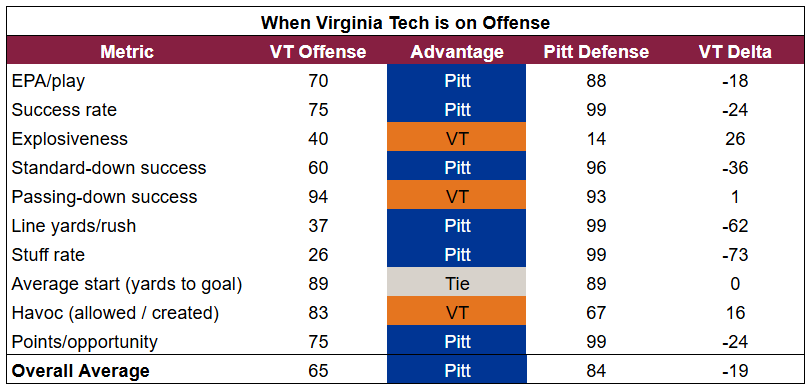
The advanced stats suggest that the Hokie offense could be in for a long night. Although Pitt’s defense does not create a ton of havoc, it does a great job of shutting down the run and getting opposing offenses behind the chains.
Pitt’s tradeoff comes as a result of its uber aggressive style. The Panthers give up a lot of explosive plays. One reason why is that Pat Narduzzi’s defense is good, but not great, at rushing the passer, so generating consistent pressure requires blitzing more often. Another reason is that the Panthers are not a very good tackling team, grading out at just 62.3 on the season, according to PFF.
Virginia Tech is only in the 40th percentile in offensive explosiveness, but Jeff Overton & Company should get opportunities to generate chunk plays, so long as they can stay focused and fight through what will surely be plenty of plays that go for little or no gain.
When Pitt has the football
Virginia Tech’s defense enjoys a similar advantage over Pitt’s offense, holding the same 6-3-1 advantage in the head-to-head comparison of advanced stats. Where Tech has an advantage, the disparity is often huge, but the overall advantage is not so great as to believe that the Tech defense can totally shut down the Pitt offense.
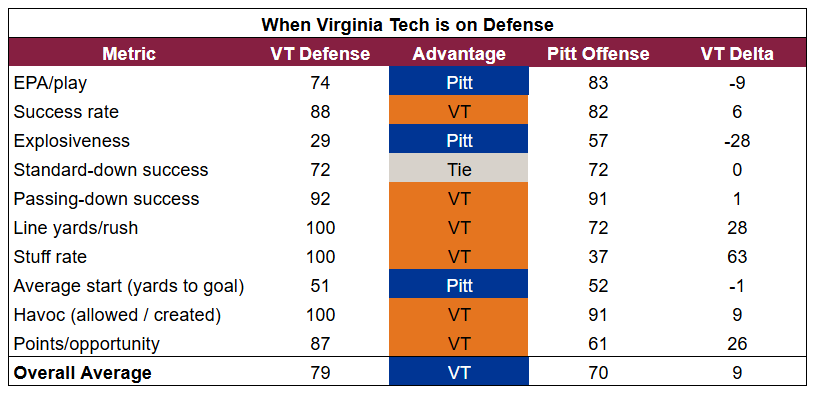
Both teams play a break-but-don’t-bend style of defense that can shut down offenses for long stretches, but then, seemingly out of the blue, allow a long scoring strike.
One other key difference is that Virginia Tech’s defense is in the 72nd percentile in Standard-Down Success Rate, while Pitt’s defense is in the 96th percentile. If the Panthers can consistently win first and second down, they stand a very good chance of winning the game.
Speaking of the game as a whole, what should the sporting public expect from this one?
The numbers give a very slight edge to Pitt which is likely negated by Tech’s home field advantage. So, perhaps this game is bound for overtime before it even kicks off?
Maybe, but maybe not.
Why all the overall stats in the world might not matter
The null hypothesis entering the game is that the two teams are very closely matched, ergo the game should be close on the scoreboard. The foregoing analysis produced nothing that would cause a reasonable analyst to reject the null hypothesis, but there is one key question that hasn’t been answered: Does Friday’s opponent resemble the whole of each team’s 2026 September schedule?
The answer is a clear no.
Half of the games each team has played have been against non-power conference teams. Padding stats in those games tells us nothing about the likely outcome of Friday’s game, but if we treat those games as being equal to the others, it could bias our expectations for this game.
Pitt’s two power conference opponents, Central Florida and Syracuse, are near analogs to Maryland and Boston College, which were wins number three and four for Virginia Tech.
Taking the average of PFF team grades from these four games paints a much different picture.
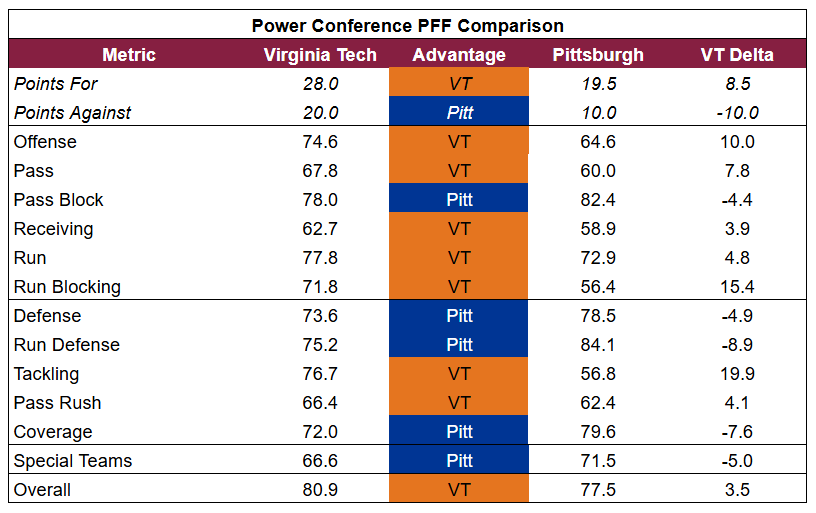
Virginia Tech has a clear edge on offense, with an overall grade 10.0 points higher than Pitt. The Hokies grade out higher in four out of the five offensive segments. Only in pass blocking have the Panthers slightly outperformed the Hokies.
On defense, Pitt has graded out 4.9 points higher, with moderate advantages in run defense and coverage. Virginia Tech is the superior tackling team (by a lot!) and the Hokies also feature a slightly better pass rush.
Pitt’s 5.0-point advantage on special teams draws them closer, but the Hokies still emerge with a 3.5-point advantage overall.
Something else to keep in mind is that both of Pitt’s games against power conference teams were at home, while the Hokies played both of theirs on the road. Not only will Friday’s game be played in Blacksburg, but it will also mark Pitt’s first road game in 2026.
For me, that is enough to reject the null hypothesis that these teams are equally matched. Virginia Tech is, at this point, the better team.
The Hokies are a 2.5-point favorite, which, if we assume a three point advantage for the home team, means Las Vegas thinks the Panthers would win a nail-biter on a neutral field. Maybe that’s why ESPN lists Pitt with a 57.8% win probability.
Those numbers are in line with what one would conclude after reviewing the overall comparison of the two teams. I just don’t think overall stats are as applicable as those against power conference opponents. Tech has played better in two games on the road against power conference opponents than Pitt has in two games at home.
And against Pitt, the Hokies will be playing in front of a raucous, Friday night crowd in Lane Stadium.
Add it all up, and the Hokies should win the game by 7 to 10 points.