


Every time I hear some version of “Ty Howle is the tight ends coach and he’s coming from Penn St., ergo Virginia Tech is going to throw to the tight ends a lot,” I feel like I want to vomit.
There are so many other factors that drove those decisions when Head Coach James Franklin and Howle were at Penn St., things that most people do not even consider, such as:
Relative athleticism of Big Ten linebackers
Ability of Big Ten programs to recruit top flight talent at cornerback
Weather conditions
Strengths and Weaknesses of Penn St. quarterbacks
Availability of blue chip pocket passers in the mid-Atlantic region
Fan expectations and the Overton window for what kind of offense can be run in Happy Valley
Comparative strengths and weaknesses of the Penn St. offensive line
This is not to say that semi-informed prognostications made in the May-June dead period do not have their place. The professionals need to generate content and the fans crave any morsel they can get.
But in the niche of a niche where Hokie Analytics lives, I have long operated under the data-driven maxim of only going so far as I felt the numbers could support.
And in the time period between when the Hokies hired Franklin and the end of training camp, that is not very far.
Now that the Hokies are set to take on their week 1 opponent, Virginia Military Institute (VMI), it would seem a salient time to discuss the metrics that, in what should be a blowout win for the home team, are most likely to reveal just how good (or not) the Hokies will be in 2026.
Week 1 metrics that matter
By the end of the first quarter, the final result of the game against VMI should no longer be in doubt. That does not mean there will not be a lot to watch for during the rest of the game. Here are the five metrics that I think will give us the best early indication of just how good Franklin’s first team in Blacksburg will be.
1) Offensive time-to-throw
Pro Football Focus’s time-to-throw (TTT) metric is always informative, but seldom authoritative. The biggest caveat is that it offers no comment on why the quarterback released the ball when he did. It could be because the play called for a quick pass, the defense blitzed, there was a blown coverage, an overmatched lineman got beaten, the defense played a soft Cover 4, etc.
Against the Keydets, who will be physically overmatched, TTT will give us a sense of the Hokies’ offensive strategy, which should offer clues about the offense’s comparative strengths. For example, lots of quick hitters would indicate that the offensive line still has a long way to go. Similarly, a lot of short drops with a longish TTT could indicate that some combination of scheme and ability is leading to Hokie receivers struggling to gain separation.
2) Count of (non-injury influenced) offensive line snaps by non-starters when Ethan Grunkemeyer is under center
If Matt Moore really believes he has depth along the offensive line, he’ll play some second string guys when Grunk is quarterback. If it’s all starters for the first half, we can safely conclude that the line is still another year (or two) away.
3) Offensive downfield shots taken (and converted)
This metric brings together many moving pieces - pass protection, route running, acceleration and top-end speed, quarterback accuracy and arm strength, and overall offensive scheme. The Hokies will probably run the ball a lot on Saturday, which should result in some wide-open opportunities on play action passes. Even if the Hokies run the expected vanilla scheme, there will probably be one or two deep shots off play action. What will be more telling, though, are the deep pass attempts off straight drop-backs.
4) Offensive line yards allowed by the defense
The result here should be essentially nil versus VMI. Anything over 1.5 yards is cause for concern. And I’m not just talking about from the starters. The average for the entire game should be under 1.5 offensive line yards allowed. If the third-stringers get pushed around late and the average drifts upward, that will tell us that the depth is not there yet. In that case, it will fall to Brent Pry and the defensive coaches to develop the second- and third-string guys during September, before the schedule gets tough.
5) Count of (non-injury influenced) back-up linebacker snaps in the first half
This is the same deal as the offensive line - a position with mostly established starters, but depth questions. There is no reason for the starters to play a lot of snaps against VMI. In fact, the second stringers should log more snaps than the starters. In particular, I want to see Sherrod Covil play meaningful snaps in the first half. He’s switching positions, is a bit undersized for a linebacker, and would generally be someone you hope you don’t have to play. If Pry isn’t confident enough to get him some action in the first half, then the Hokies could be one Kaleb Spenser twisted ankle away from disaster.
Team talent
Twelve of the ACC’s seventeen teams are ranked in the top 50 schools nationwide in the 2026 composite team talent metric. Among those teams, Virginia Tech is fourth (27th overall).
That’s the good news.
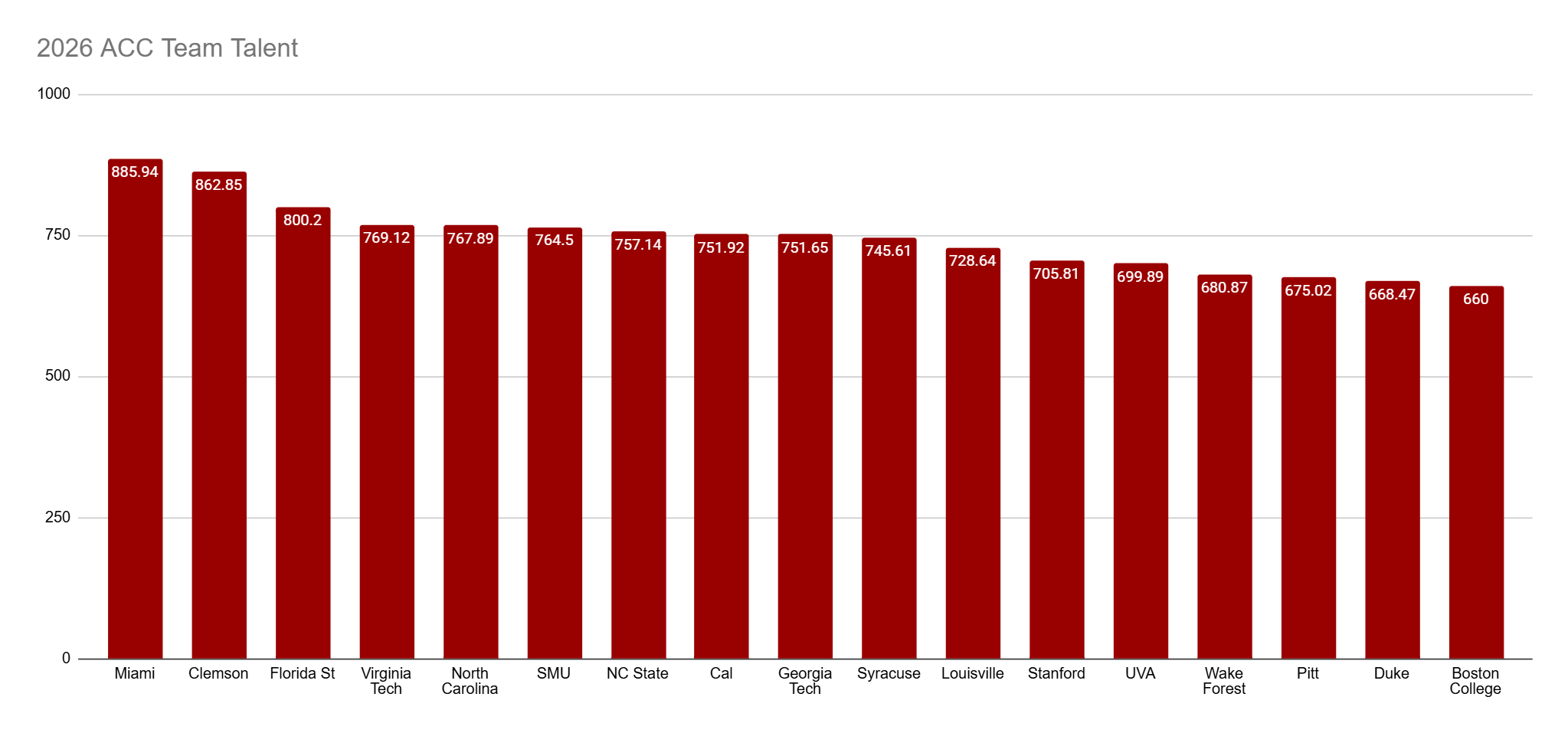
The bad news is that Virginia Tech’s most talented players - in terms of original high school ratings, which comprise this metric - are also among its youngest. Put another way, Tech’s starters are numerically less talented than its backups.
Of course, high school ratings are not everything. Development matters. See: Marcellous Hawkins and Kemari Copeland.
Still, when looking at the team as a whole, that pesky fact matters, especially with the glut of teams whose talent rating nearly matches Tech’s:
28th - UNC
31st - SMU
32nd - NC State
33rd - Cal
34th - Georgia Tech
35th - Syracuse
Among the teams on that list, the Hokies play at Cal and SMU, and get Georgia Tech at home.
Tech also plays two ACC teams with higher talent ratings - Miami (12th) and Clemson (16th).
Overall, six out of Virginia Tech’s nine ACC opponents (Stanford sneaks in at 50th) are in the top 50 on Team Talent. Notable among the three that are not is Virginia, which checks in at 53rd, and Pitt, which is 64th.
Here is what all of this means from an expected results perspective:
Expected record against teams with more talent (0-2)
The Hokies travel to both Miami, a likely but not certain loss, and Clemson. The Tigers are trending down and have questions at quarterback, but their schedule sets up nicely in the weeks leading up to their tilt with the Hokies.
Expected record against teams with similar talent (1-2)
Georgia Tech, which lost at home to Colorado 14-13 on Thursday night, is a very winnable game at Lane Stadium. Cal and SMU are both road games, and therefore will be uphill battles
Expected record against teams with less talent (2-0)
UVA looked good in dismantling NC State last week, but quarterback remains a question, and it has been decades since the Cavaliers beat the Hokies twice in a row. Pitt comes to Lane Stadium on a Friday night, which gives Tech a distinct advantage.
Expected record against teams lacking P4 talent (1-0)
Boston College will have home field advantage, so the game may be closer than Hokie fans would prefer, but Tech should nonetheless prevail.
Expected record against non-conference opponents (3-0)
Maryland, ranked 46th in team talent, can and should put up a fight, but James Franklin has a history with the Terrapins, and the Hokies should be very locked in for that game.
Based on team talent, and factoring in where the games are played, fans can reasonably expect the Hokies to finish 8-4 overall, and 5-4 in the ACC. The likelihood of going 7-5 is greater than 9-3. In fact, 9-3 is nearly as likely as 6-6. And if Ethan Grunkemeyer were to get hurt, the Hokies could easily fail to win half their games.
If Tech wins 7 or 8 regular season games, the fanbase should be pretty happy. But just to show how far James Franklin and his staff will still have to go to compete on the national stage, the difference between the most talented team, the Georgia Bulldogs, and the Hokies is 334.55 rating points. That is more than three times the 109.89 rating points that separate Virginia Tech and Boston College, the least talented team in the ACC.
Excellent analysis! I especially like how you're trying to squeeze as much information as you can from (1) roster talent, and (2) possible results of the VMI game. Keep up the great work!